Wednesday, May 31, 2017

A Comprehensive Beginner’s Guide on How to Use Guitar Tabs

Guitar tabs are a godsend for most guitarists. They allow us to easily figure out how to play a song by plotting out numbers, which correspond to your guitar’s frets, on six lines which correspond to your guitar’s strings. This is a much easier method than using traditional music notation as you don’t need to memorize what each note looks like. Instead, just match up the numbers and lines in the tab to the frets and string on your guitar and you’re good to go.

Whether you’re a beginner guitarist or just need a refresher on how to read tabs, I’m going to cover everything you need to know about guitar tabs in this post.

How to Read Guitar Tabs

Guitar tabs are extremely easy to read once you get the hang of them. A typical guitar tab is made up of 6 lines, each one corresponding to a string on the guitar. The example below shows what an empty tab sheet looks like:

e------------------|
B------------------|
G------------------|
D------------------|
A------------------|
E------------------|

The small “e” corresponds to the thinnest string on your guitar and the big “E” corresponds to the thickest. Once the tab sheet is populated, every number that you’ll see on a particular string will correspond to the fret that needs to be played on that string. Let’s look at example A:

e------------------|
B------------------|
G------------------|
D-------------0--2-|
A------0h2---------|
E----3-------------|

It’s important to read all tabs from left to right. The above tab outlines the first few notes to Pink Floyd’s “Wish You Were Here”. This tab can be broken down into 3 parts:

  • The first note that you’ll play will be on the 3rd fret of the low (thickest) E string.
  • You’ll then play the open A note (0 corresponds to open notes) and hammer on to the second fret of the A string (“h” stands for hammer on).
  • Lastly, you’ll play the open D string and finally the 2nd fret of the D string.

Pretty simple right? Let’s look at example B:

e--3--3--3--3-3-|
B--3--3--3--3-3-|
G--0--0--0--0-0-|
D--2--2--2--2-2-|
A--2--2--2--2-2-|
E--x--x--x--x-x-|

The above tab example is the second measure of Wish You Were Here. In this example, you’ll notice that all the notes are stacked instead of being offset from one another. This means that you need to play those notes at the same time (in this case they create a chord). The “x” means you shouldn’t play that note or it should be muted. All of the other numbers tell you which frets you should be pressing down.

Now, if we put both parts A and B together we get this:

e------------------|-3--3--3--3-3-|
B------------------|-3--3--3--3-3-|
G------------------|-0--0--0--0-0-|
D-------------0--2-|-2--2--2--2-2-|
A------0h2---------|-2--2--2--2-2-|
E----3-------------|-x--x--x--x-x-|

As you can see, the first part of the guitar tab is all single notes which you’ll want to pluck. The second part, however, is all the same chord which you’ll want to strum 5 times.

That should give you a good overview on how to read tabs. All tabs are really more or less the same with the exception of a few special characters that you’ll come across. I’ll talk more about those in the next section. If you need a little more guidance on how to read tabs, I’d recommend checking out this great video walkthrough.

Guitar Tab Cheatsheet

As you’re looking through certain guitar tabs you may come across some that contain special characters such as:

  • h
  • p
  • / or \
  • x
  • b

Each of these has a specific meaning and let you know how the tab should be played. If all of this is still fairly new to you, consider keeping the guitar tab cheat sheet below handy in case you need to quickly look up what these characters mean.
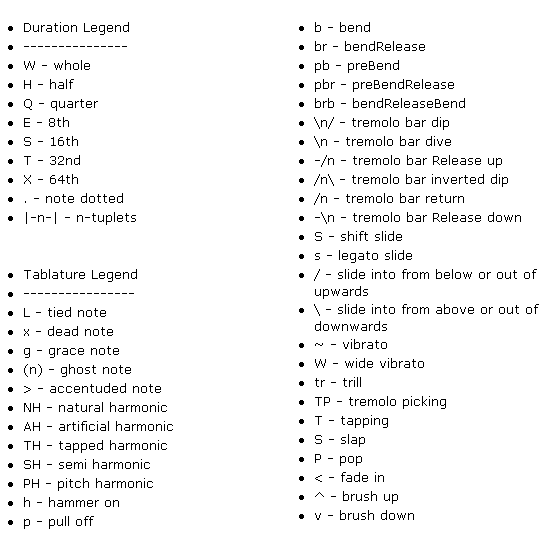
guitar tab legend

5 Awesome Guitar Tab Websites

There is really no shortage in the number of guitar tabs out there; Ultimate-Guitar has over 1 million alone. More often than not, if you want to learn a new song on guitar, someone has already created a tab for it – which is a great reason to organize your tabs with an app like Practice Book. There are many fantastic resources out there to find guitar tabs but in my opinion, these are the top 5 guitar tab websites.

911 Tabs

  • ultimate-guitar – One of the most popular guitar tab websites. They offer loads of guitar, bass, and ukulele tabs in various formats.
  • 911tabs – Similar to Ultimate-Guitar, they also offer tabs in various formats. Additionally, they also focus on drum tabs and piano tabs as well.
  • gtptabs – Another resource for finding quality Guitar Pro tabs, if you can’t find it on guitarprotabs.org, check gtptabs.com.
  • songsterr – Songsterr is a bit unique in that they offer a huge collection of tabs however most of them are actually playable directly from within the website. This is great for guitarists who want to follow along with the tab by being able to hear what it sounds like, without having to download a program.

Guitar Tab Tools

Similar to guitar tab websites, there are also various guitar tab tools out there that can help you learn songs faster. As I mentioned above, Guitar Pro tabs are essentially “playable” tabs that you can hear and see, thus making it easier to get a feel for what the tabs are actually doing. One pitfall of using guitar tabs as opposed to music notation to learn a song is that the timing in guitar tabs is often ambiguous and difficult to determine. That’s why, if you’re learning a song from just a guitar tab, I always recommend keeping the song itself handy so that you can go back and listen to how it actually should be played.

However, that major problem is something that guitar tools such as the ones mentioned below are able to fix. With these tools, you can simply download a Guitar Pro tab file, open it and have your computer start playing the tab in real-time. A couple of tools I recommend for this are:

Guitar Pro 7

  • Guitar Pro – This is the ultimate music editing software. If you’re looking for a great tool to not only play Guitar Pro tabs but also look up chords, scales, write music, and much more, Guitar Pro is the answer.
  • Tux Guitar – Basically the “lite” version of Guitar Pro. Tux Guitar doesn’t come with all of the bells and whistles that Guitar Pro does, however, if you don’t want to spend any money but still want to be able to play, create, and save guitar tabs then Tux Guitar is the way to go.

Conclusion

Guitar tabs are an extremely useful way to learn how to play music. Learning how to read tabs takes a bit of practice but within a couple of hours you should be able to get a good grasp of them and will be learning songs in no time. Remember to check out the guitar tab tools mentioned above to even further accelerate your learning process by being able to hear and move along with the tab as your computer or phone plays it out for you.

Lastly, if you’re looking for a list of easy songs to get started with, I’d recommend checking out this collection of 100+ easy guitar chords songs or easy guitar tabs songs. Happy guitar playing!


Author bio:

Cody is the founder of Musician Tuts, a free tutorial hub for musicians. He has over 10 years experience playing guitar, drums, bass and audio engineering. He spends his days blogging, listening to Spotify, and playing music.

The post A Comprehensive Beginner’s Guide on How to Use Guitar Tabs appeared first on The Guitar Journal.

Friday, May 26, 2017

Sell-Off Rights for Merchandise

The sell-off rights to merchandise aren’t well known to all musicians. However, it is something you should be aware of before you start to work with a merchandiser.

What are sell-off rights?

This simply means that the merchandiser doesn’t have the right to manufacture more merchandise right before the contract is over. They can only sell what is left in stock. Most merchandiser will ask to sell it through retail outlets as it won’t be sold on concerts. The artist will get royalties of these pieces that get sold. There should be no question in that. Before you take this step, there are a few things you, as an artist, need to ask for.

Buy it Yourself

Before the merchandiser sells your merchandise after your contract has ended, he or she should give you the chance to buy the rest of your merchandise back. If you have merchandise that you only sold online, it could be a good idea to start selling that merchandise at concerts too. It gives your fans the chance of having that one shirt they couldn’t order.

If you don’t buy the rest of your merchandise, the merchandiser will get a sell-off period. This can be anywhere within 6 months to a year. Just make sure that the sell-off rights are non-exclusive, so that if you work with another merchandiser you won’t get in trouble. And, the merchandiser cannot stockpile the merchandise. This means that they can’t manufacture more merchandise right before the end of the term. If you’re making an agreement, try to get this in the contract. Ask that they only manufacture a specific amount of merchandise so that this doesn’t happen.

Distress Sales or Dumping

Ask them to put this in the contract too. This means that merchandisers cannot sell your merchandise at very low prices just to get rid of the stock.

If you do get a sell-off rights agreement, they should ask you by the end of the term if you want to buy the remaining stock. If not, you ask them to get rid of the merchandise. With this meaning, destroying it. Or you ask them to donate it to charity.

The post Sell-Off Rights for Merchandise appeared first on Help For Bands.


Read Full Article Here: https://www.helpforbands.co.uk/sell-off-rights-merchandise/

Saturday, May 20, 2017

Phil Keaggy and His Craft

I first encountered Phil Keaggy when I was probably 3 or 4 years old. My dad was jamming out the chords to “Full Circle” on his acoustic guitar (my brother still plays that lick 30 years later).

Since then, he’s floated in and out of my musical awareness as I’ve appreciated his virtuosity, artistic transformations, and, of course, his nostalgic appeal.

You can read a lot about Keaggy on his excellent website, but the short version is this:

  1. The Bio: He started playing as a young kid in Ohio: e played electric in several bands; and went solo, riding the rising swell of the Christian music industry. The 90’s saw him tackle (i.e. dominate) the acoustic guitar and explore new ground in solo, looper-based performances. And even now, he continues to produce albums and perform for a long-devoted fanbase.
  2.  The Myth: It’s possible that you may have heard Keaggy’s name from the famous Jimi Hendrix rumor which is, by the way, untrue according to Snopes. I won’t perpetuate the error, but it’s usually the first thing mentioned by guitarists when Keaggy’s name comes up.
  3. The Truth: You may also have heard that he’s missing part of his middle finger on his right hand and, yet, STILL somehow manages to pump out staggering fingerstyle guitar arrangements! This one is true.

But if you haven’t actually heard him, though, I would try listening to Addison’s Walk for some great acoustic fingerstyle playing.


So What’s New? Master Course!

Keaggy recently released a series of Master Course lessons on JamPlay.com. This is a welcome addition from a master of the acoustic guitar.

Phil Keaggy - Master Course - JamPlay

In these lessons, Keaggy covers technique, practice exercises, and tone and gear recommendations.

I’m particularly excited by the section on “Loops, Delays, and Pedals”. He’s done such amazing stuff with loopers (waaaay before Ed Sheeran!).

The lessons are framed as a “Master Course”. So, when you buy the package, you have the materials for life (as opposed to JamPlay’s typical subscription model).

JamPlay is also Live Master Class and Guitar Giveaway.  So lots of fun stuff going on!

You can find all the exciting details here.

P.S. CLICK HERE to get a a 25% discount on the Master Course (up until June 15).


P.P.S. Here’s a preview of Keaggy’s very approachable teaching style in a sweet capo and looping lesson. Special thanks to Elixir strings for making the cool video ; )

The post Phil Keaggy and His Craft appeared first on The Guitar Journal.
Tuesday, May 16, 2017

What Not to Forget When You Start a Band

When you start a band the idea of making the logos and going on tour is the dream, right? But, there’s always a catch. There are things that starting bands always seem to forget, something that can be very crucial for in the future.

Branding

Make sure you protect your logo and the band name you use. To find out if your name hasn’t been used before, the internet is your friend in this case. Don’t just Google the name, check social media too, because this is where you are going to spend your time promoting your music.

You don’t want to confuse people and you want to be original as possible.

What If the Band Splits?

Talk to the band about this. Don’t wait until you are in a courtroom. There are different things you need to discus, if the band ever splits. It doesn’t mean that you’re waiting to split, it means that you are preparing yourself for if anything does happen when there is a fight and the band wants to split.

Like, can the band still go on if 2 members have left? Can the remaining members still use the band name? Writing it all down on a written agreement makes things easier for later if this does happen.

That’s not the only thing you need to think about, what if one band member isn’t what you thought he was? And you want to get rid of him? What kind of vote in the band do you need to vote (or fire, it’s how you look at it) a member out of the band?

If you’re in a record label, this means a few other things too. Like, will the band be kicked out of the label if the band splits? What if someone gets out of the band to work on a solo project, will the label push the solo artists to be signed under them?

Remember this When you Start a Band

Ask yourself these questions when you start a band, do it while you’re still friends and everything is done on a friendly note.

You don’t want a split to be uglier than it needs to be.

The post What Not to Forget When You Start a Band appeared first on Help For Bands.


Read Full Article Here: https://www.helpforbands.co.uk/not-forget-start-band/

Thursday, May 11, 2017

Can Sponsoring Help a Band or Artist?

Some artist or bands may think that getting a sponsor is like making a deal with the devil. You sell your soul for the one thing you most desire, fame. But is that really the case? We don’t think so. You have to be smart and see where the opportunities lay in the industry.

Is Sponsoring Bad?

Some bands have fin with their sponsorship deals. Look at the extreme product placement from All Time Low did in their ‘ I Feel Like Dancing’ video.

It’s a bit extreme, but its a good example of making fun of sponsorship deals. And it doesn’t mean you’d have to sell your soul to do what you love. Yeah, sure, All Time Low probably got a lot of money out of it from Rockstar Energy, but think about it this way; more money, means more investments in your band or music.

With the money you get, you can invest in new materials for tour. Or you could invest in new merchandise. You could even use some of your sponsorship money to pay for new recordings and studio time. Do something special and manufacture limited edition vinyls! It can really expand your creativity and once potential new fans see how creative you’re getting with your sponsorship, and you don’t overdo it at live shows, they could actually start paying more and more attention to your music.

But make sure you do it for the right reasons. It’s good to have some extra money in, but don’t be a sell-out. Be smart and be creative.

So, do you still think that sponsoring is a bad thing?

The post Can Sponsoring Help a Band or Artist? appeared first on Help For Bands.


Read Full Article Here: https://www.helpforbands.co.uk/can-sponsoring-help-band-artist/

Tuesday, May 9, 2017

I Lov Guitars Pick Review

I Lov Guitars sells premium guitar picks online. They claim to be the “first guitar pick company to offer picks on a subscription basis (monthly, quarterly or semi-annually)”

Assorted_Picks_1024x1024

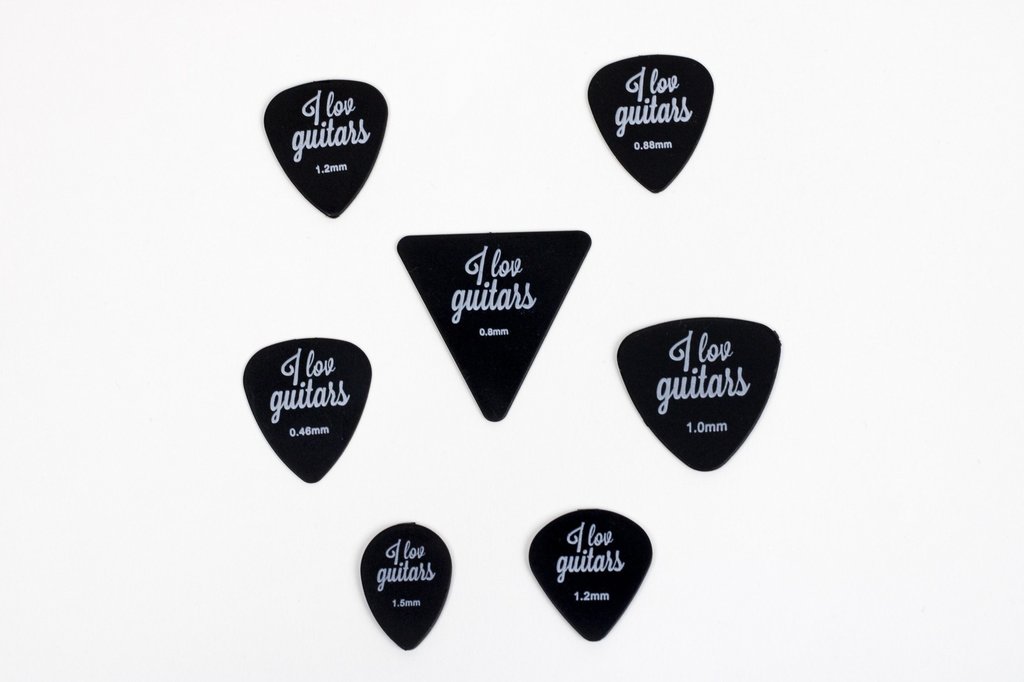
The Assorted Guitar Picks Pack (Photo Credit: I Lov Guitars)

I Lov Guitars picks are made from Acetal Delrin(R) and come in multiple gauges and shapes. Their picks have a special grind texture to prevent it from easily slipping. They have picks for acoustic and jazz guitars that all come in the color black. They also have large triangular picks which are great for beginners making it easier to grip with its large surface area.

Their subscription service is ideal for guitarists who practice several hours a day and need to constantly replace their picks. As a big bonus, they also provide free shipping worldwide on all their picks. What’s not to like about them?

I got the Assorted Guitar Picks which come in a variety of sizes, but I focused on the acoustic-specific picks:

Standard Medium Guitar Pick 0.88 mm

Standard Medium Guitar Pick 0.88 mm (Photo Credit: I Lov Guitars)

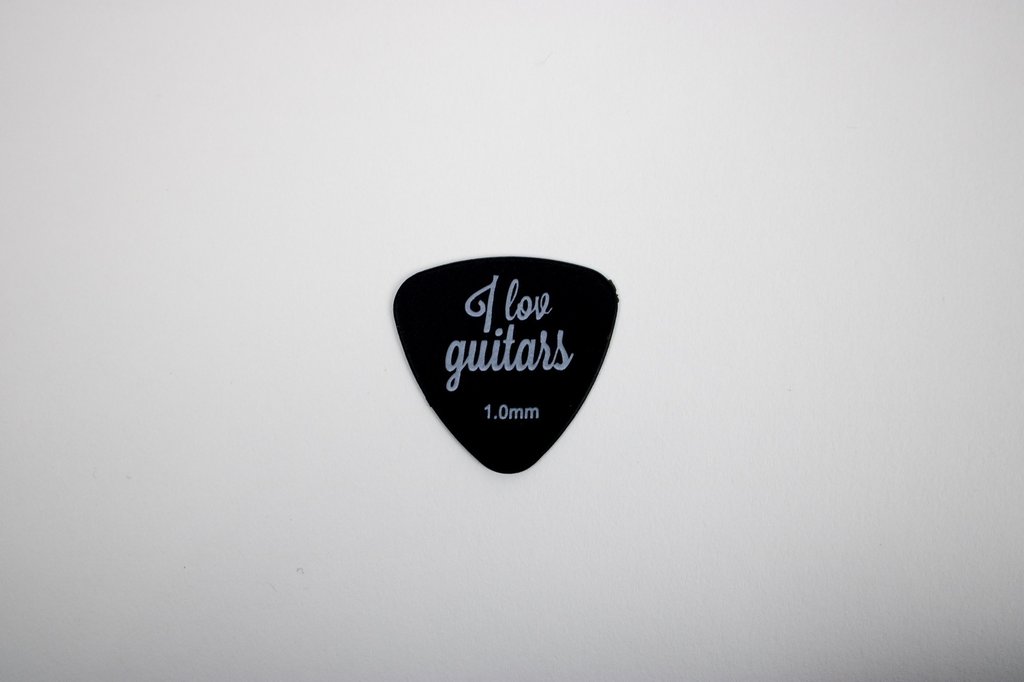
Large Triangle Acoustic Guitar Pick 1.0 mm

Large Triangle Acoustic Guitar Pick 1.0 mm (Photo Credit: I Lov Guitars)

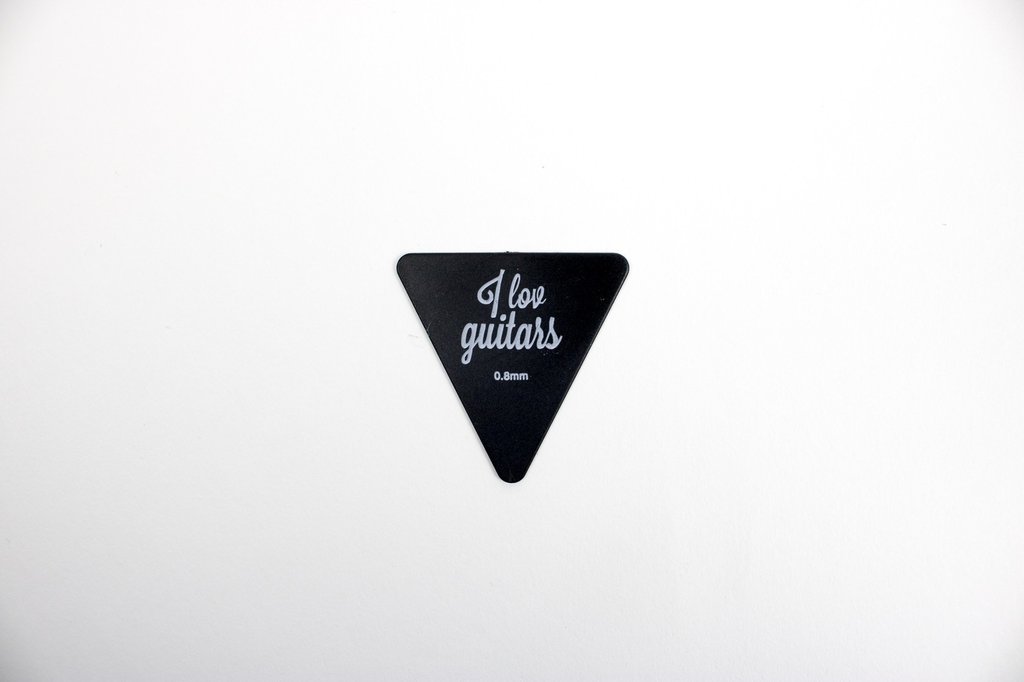
Large Triangle Acoustic Guitar Pick 0.8 mm

Large Triangle Acoustic Guitar Pick 0.8 mm (Photo Credit: I Lov Guitars)

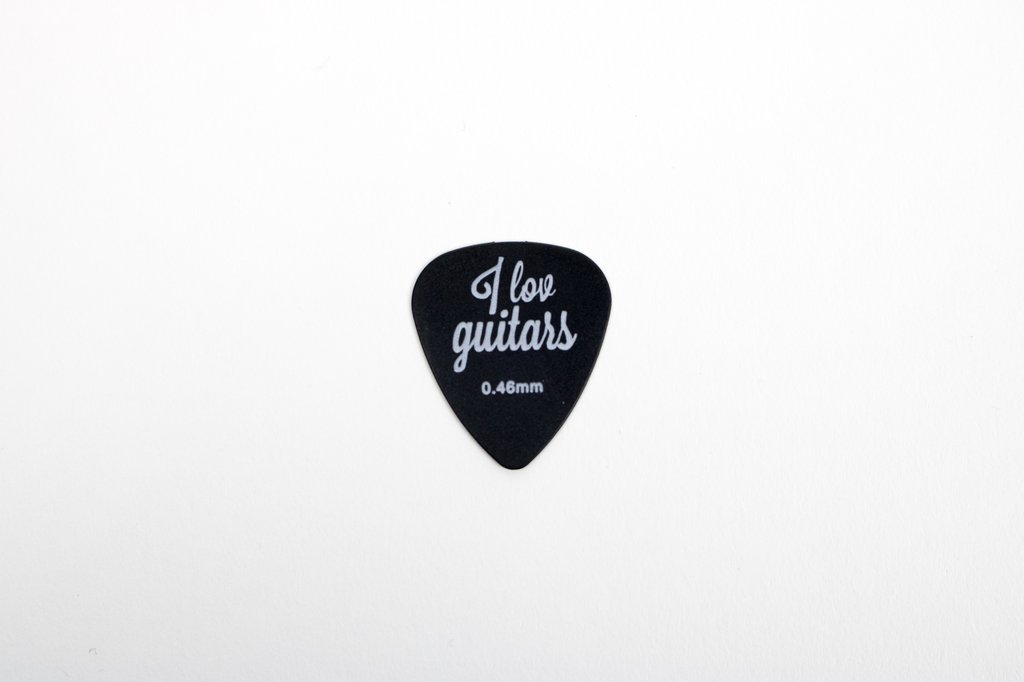
Standard Light Guitar Pick 0.46 mm

Standard Light Guitar Pick 0.46 mm (Photo Credit: I Lov Guitars)

The Pros

  • The pick material is strong, unlike some ahem, Fender picks with tortoiseshell that have literally fallen apart in my hands.
  • Tone is warm.
  • The black and white look is nice.
  • The Standard Medium 0.88 mm sounded and felt superb. Versatile for strumming and picking, warm tone, easy in the hand.
  • The Standard Medium 0.46 mm had nice tone and felt good. Would be good fit for heavy strumming.

The Cons

  • The material is so smooth and thin that you have to keep a firm grip on them. I prefer Dunlop’s raised ridges that give you a bit of grip on the pick.
  • I noticed a little plastic tab hanging off the Large Triangle 1.0mm and Standard Light 0.46 mm pick. Looks like it was just a sloppy job cutting them from the mold.
  • I’m not a fan of the Large Triangle 0.8 mm pick. The size and corner angles are exaggerated, making for large, ungainly pick. Holding it is awkward and the tone is not nearly as good as the Standard shaped picks. Can’t imagine a scenario where I would use this.

Recommendation

If you want a great pick that’ll work in lots of settings, get the Standard Medium Guitar Pick 0.88 mm.

If you want to experiment with several types, get the Assorted Guitar Picks.


For $9.99, you can purchase the picks in packs of 10. They have a wide range of payment options giving you flexibility in how you shop. They accept American Express, Apple Pay, Bitcoin, Mastercard, PayPal, and VISA. I Lov Guitars has a large following on Facebook, check out their Facebook page if you are interested in joining their community.

The post I Lov Guitars Pick Review appeared first on The Guitar Journal.

Friday, May 5, 2017

App Review: Keeping Your Tabs Organized with Practice Book

Practice Book solves a basic problem for all sorts of guitarists:  quickly accessing your favorite tabs.  If you’re like me, you often look up a tab (or ten) and simply leave them open in the web browser while you play.  Then, the inevitable happens.  A week later, you refresh your whole browser, and poof!  Those tabs are gone.  Sure, you could search for them again.  And, sure, they’re in your browser history. But these routes add unnecessary friction to your main goal:  sitting down and practicing.  Practice Book is a handy way to save those tabs in one place.

It also solves a few other problems with tabs:  organizing them, editing them, and making them easier to play along to.

For those new to music notation, tabs are short for tablature and is written based on an instrument’s fret fingering positions. They are often written in plain text making it easy to read and access.

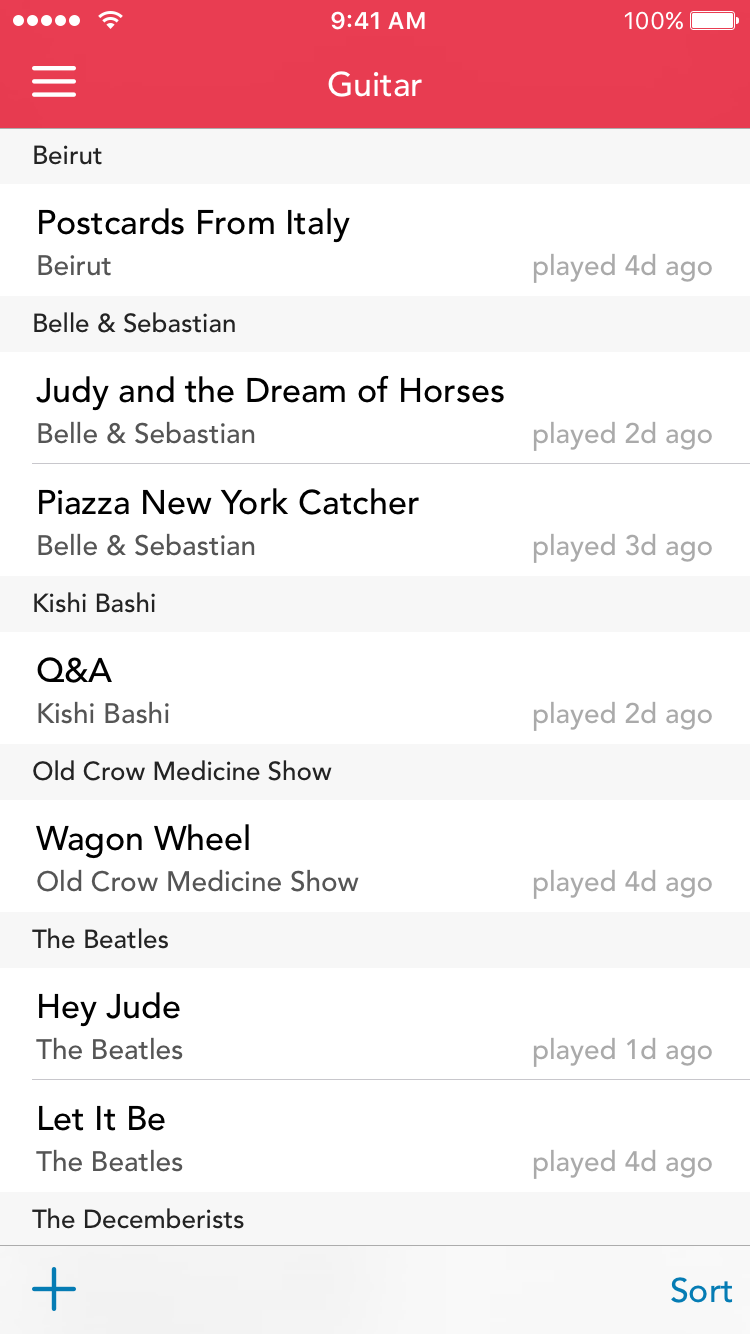
Practice Book iOS - Library

Practice Book is an app that organizes tabs for string instruments such as guitar, ukulele and bass. It currently only supports plain text tabs, but will support more formats with future updates.

Some of the main features include:

  • Chord highlighting
  • Reliable iCloud sync
  • Search, sort and organize songs into folders
  • Import from iTunes File Sharing and other apps
  • Easily find and add songs online
  • Automatic weekly backups
  • 3D Touch and Haptic Feedback
  • Library export

Here’s a list of Pros and Cons from the perspective of the free iPhone app.  The desktop app is an even easier way utilize Marc Charbonneau’s vision for Practice Book, but I find that I use my phone most frequently for looking up and quickly accessing tabs.

The Pros

  • Importing tabs:  It’s super easy.  You can import a Word file from Dropbox, iCloud, or other file apps.  Or, more importantly, you can search the web from within the app and import the tab.  This worked remarkably well.  I imported 4 different songs from the web within a few minutes.  Using this app with sites like Ultimate-Guitar.com seems like the ultimate power combo for building a personal tab library.
  • Editing tabs:  You can “pre-edit” or “post-edit”.  What I mean is: You can select which part of a tab to import.  You simply use the normal cut’n’paste selection on your phone to grab the part to edit.  Or you can edit an imported tab after the fact.  This is useful for correcting errors, adding sections, etc.
  • Works offline:  This is important to me because there are (surprisingly) a number of situations and times where internet access is spotty.  Knowing I’m not relying on my phone’s internet connectivity is super helpful.


Practice Book iOS - Music Tab

  • Auto scroll:  This simple feature is a life saver.  Typically, even on a desktop, you’re faced with the choice of zooming the tab out so you can see everything at once, or pausing mid-song to scroll down to the next section.  PracticeBook’s auto scroll allows for smooth and slow scroll as you play to avoid this conundrum.

The Cons

I didn’t discover a lot of cons.  The app worked smoothly and intuitively.  Two things to note though:

  • No PDFs:  I couldn’t import a PDF of a tab from the internet option.  This is disappointing because there are often high-quality PDFs available online, particularly of complex fingerpicking songs, that I would love to store in PracticeBook.  This would be desirable for PDF files so that I could open them within the PracticeBook app.
  • Ads and stuff:  No surprise here.  As per the current industry standard, PracticeBook is free as an app with a paid ($3.99) version that removes ads and, also importantly, supports the developer.

The app is developed by Once Living LLC. Once Living is the work of Marc Charbonneau (@mbcharbonneau on Twitter) from Portland, Oregon. Marc has been developing apps for OS X since 2004 and playing guitar for nearly as long.

Download the free app for iPhone here.

Download the app for the desktop version for $19.99 here.
Note:  The desktop version is $19.99 but, at time of this writing, it is running a 50% discount, so you can get it for $9.99.

The post App Review: Keeping Your Tabs Organized with Practice Book appeared first on The Guitar Journal.
Tuesday, May 2, 2017

VIP-ticketing: The Good and the Bad

You see it everywhere, the VIP ticket options to meet your favourite artists with sometimes prices too high for what it should be. We are here to show you the good things about VIP-ticketing and the bad sides.

The Good

It shows your fans you’re willing to meet them. The die-hard fans will obviously jump to this possibility to meet their heroes.

It’s nice if you give fans something extra. Like, a lot of bands and artist put a lot of time into thinking of a way to make a full package of the VIP ticket. Like, try to give them more than just a hug and a picture with their favourite band or artist. Try to give them something extra like a merchandise package. Give them the chance the chill out with you with a pizza party or something else like this.

The Bad

You see pop stars exaggerate with the prices and some people will actually pay for it. But not everyone gets the chance to buy them. Fans will feel left out and then get mad at the artist. This is never good, because you don’t want to lose fans just because of the prices. This is the same for concert tickets.

It eliminates the fans with a smaller budget. You don’t want to do something like that. Of course, it all depends on what the age of your public at concerts is. If the age is, let’s say 12, you wont earn much for VIP-tickets if they are really expensive. You’d have more chance with teenagers of 16-18 year-old. Because thats when they start working in most cases.

All in all, its a good idea to do this. Just be careful and don’t do what Ozzy Osbourne did at Graspop Metal Meeting 2016. He asked 950 dollars for a meet & greet at the festival for 15 minutes before the show. Which is crazy and no one paid for it. Just be mindful of the price for your fans and give them that little extra that will make it the best night of their lives.

The post VIP-ticketing: The Good and the Bad appeared first on Help For Bands.


Read Full Article Here: https://www.helpforbands.co.uk/vip-ticketing-good-bad/