Wednesday, August 31, 2016

International Marketing Advice from No Angel Records

Here at Help For Bands, we are always trying to write blogs that musicians of all styles and abilities can relate to. We are also always trying to find international opportunities for our Help For Bands subscribers in our monthly opportunities newsletter.

With this in mind, we thought we would catch up with one of the companies who gave us an international opportunity for our newsletter, and ask his opinion on the importance of building relationships worldwide in the music industry.

International Marketing Advice from No Angel Records


Jonas Olsen works in communications, PR and marketing for No Angel Records in Denmark. This means he promotes music daily and scouts for new music for the label. He also works with creative media producers such as directors, editors and ad agencies. Here, he gives his insight into the making international relationships in the industry, and the advice he would give to artists about marketing themselves.

Have you ever worked with musicians outside of Denmark?

“We work with musicians from all over the world. Estonia, Canada and the U.S. are just a few examples. This goes not only for musicians but other publishers as well. We don’t believe in borders when it comes to musicians and music.”

How did this relationship come about? i.e. did they approach you or vice versa, how did you find each other?

“Well, both actually. We’ve reached out to some bands and others have reached out to us. Lately a lot more have reached out to us and we’ve made it very easy for artists to submit their music to us via our website. A lot of them have found out about us via our digital campaigns and we’ve found a lot of bands via independent music blogs and international music / media events such as SXSW and Tallinn Music Week.”

Do you believe there are benefits to creating relationships with people in the industry internationally?

“There are many benefits. I think musicians underestimate the power of an ‘international audience segment’ approach which an international network can give you. What doesn’t work in Denmark might work in Russia and vice versa. One of our Danish artists is quite popular in Poland, a country with a population of approx. 40 million people – 8 times more than Denmark. This was only possible due to our international network.”

Win-lyric-video-free-prize-draw


From your experience in promoting music, what advice would you give to artists about making themselves and their music marketable in such a competitive industry?

“Consumers yearn for substance and meaning right now, and underground musicians aren’t good enough at delivering. To me, one of the most frustrating things is a musician that doesn’t know what they’re really good at or lacks a clear idea of what he / she wants to convey with his / her music. ‘I can play all genres and sing about everything’ just doesn’t cut it. Identity and individuality is key. That doesn’t mean that your music can’t evolve. It can. But you have to have a clear message and an identifiable style every time you promote your work. The artist’s message and personal identity is just as important as the music itself. Identifying popular and topical subjects is also an option if you want your songs to be more relevant and relatable to a broad audience.”

International Marketing

So, there you have it. Assessing yourself and the music you want to create could be the key to identifying whether you have a marketable product.

Do you have an individual identity in your music? 

How would you describe yourself? 

Knowing this could help you find international opportunities as well. Just because the country your from isn’t taking much notice of your music doesn’t mean that another one won’t either. Find the right market for your music.

For the chance to find some international opportunities with labels, managers and publishers from around the world, sign up to our monthly opportunities newsletter where you can get the contact details of these companies.


No Angel Records make it easier for great upcoming bands and artists to get noticed via media placements while the media industry gets an easier time finding great affordable bands for their commercials, TV productions and films.

No Angel Recordsnoangelrecords.com

https://www.facebook.com/NoAngelRecords

https://www.youtube.com/channel/NoAngelRecords

https://soundcloud.com/no-angel-records


Read Full Article Here: http://www.helpforbands.co.uk/international-marketing-advice/

Monday, August 22, 2016

How to find Songwriting Opportunities

Ways in which I first started writing for other people came to me as such a surprise. I’d just started university and decided that a career in publishing from a recent lecture had really influenced me to get into that sector of the music industry. I started doing some googling into publishing deals including what they expect of you and what they’re all about. For a few weeks after that I starting writing to briefs from ‘Sentric Music’ as they upload real life briefs for sync deals on their website. I never submitted anything but always gave them a go.

How to find songwriting opportunities


A few weeks down the line and I attended one of Manchester’s best known events. ‘Manchester’s Networking and Industry event’. Everyone from producers right through to music photographers attends, it is basically for anyone looking to work with others in the music industry. You name it they were there.

Magically, I stated on my nametag that I was a songwriter. I then met a guy called Feri, a great bloke who I work quite closely with now. Feri is a producer who works in the Swedish dance sector of the industry but also branches out to elsewhere with his music. We spoke for a bit in the loud crowd, exchanged details and he said he’d be in contact. Me being me, I thought nothing of it and well, to my surprise Feri called me up. He asked if I’d like to write towards a recent track he was working on for Universal. Exciting times this really was.

After he sent through a brief via email I started working straight away and came up with a simple little track called ‘The One’. I didn’t feel was great at first and I had many more ideas up my sleeve, but to my surprise Feri loved it. We then organised a meeting and met up at Feri’s house in Manchester. I went to his studio and recorded a demo of the track. Contracts were exchanged etc. with PRS and royalty splits and so on. I’d written for my first real life brief. It actually became rather successful. It had something like 200,000 streams on Spotify and was in the top 40 of some European country. And that was with my demo vocals produced onto it. I felt so proud.

Occurrences from similar events and recommendations by word of mouth these wonderful opportunities kept coming. I then started writing for indie labels after creating original music for pop boy/girl bands and so forth. Pop music just became something I loved writing. As an original artist writing pop/country/rock music it all felt rather natural.

Then came a night where I decided to attend a PRS event. PRS for Music is how original artists earn a living on music they’ve written either for themselves or other artists. (If you write your own music I’d recommend getting it). I knew a fair bit about PRS for Music but I wanted to attend and learn the ins and outs so I really knew what I was doing.

There were many industry professionals on a panel talking about their work in the music industry. Up on the panel was a man called Richard Broadman from Delphic/The Six. (If you don’t know who he is, he wrote Jess Glynn’s No. 2 in 2015 and toured with Oasis). He spoke about what he does in the industry now and how he had worked with various artists and writing teams. I learnt a lot from his industry panel talk.

olly flavellAt the end of the overall evening I saw Richard and decided to go over and chat. Explaining who I was and what I did by writing for other people and how I was looking for work as a freelance songwriter we exchanged details with an email. I then later that night stayed up rather late writing an extremely formal email about my work and how we met and so on. It’s more like writing a musical CV.

 
I then sent that email thinking I’ve given it a shot if nothing comes back, and if not then not to worry.  A few days later I received an email from Richard saying how he liked the work I had done and would be in contact. Now opportunities like this don’t come around very often but Richard sent through a demo brief for ‘Little Mix’s’ newest 2017 album. I was blown away at the same time as amazed. I started working straight away pumping out as many ideas from the brief as possible. We then bounced ideas back and forth from each other. I was blown away and felt incredibly honoured to receive an opportunity like this. I have now worked with more indie labels and people looking music for sync etc.

How to find these kind of events yourself:

  1. Approach people and feel confident in what you do. I also find having a good starting line to approach is a great starter. Something along the lines of “Hello, I’m ‘So, so’. I’m a singer-songwriter looking for work with other artists. I have written for etc”. Then let the conversation continue from there.
  2. Business cards. They are an essential. Don’t exchange details with a scrap piece of paper. Be as professional as possible.
  3. Have something to present. A well presented and produced CD. This a bonus to keeping as professional as possible.
  4. Do your social media correctly. Present it in an easy accessible and presentable way in which people can find it.
  5. Find events using event sites like Event Bright. These are great and beneficial ways to connect with people face to face.

Read Full Article Here: http://www.helpforbands.co.uk/find-songwriting-opportunities/

Friday, August 19, 2016

Guitar Sense GS-T1 Tuner Review

There are a lot of small, inexpensive tools that make guitar life much easier – a capo, a guitar string tool, a metronome.  But an absolutely indispensable one of these tools is the guitar tuner.

The New Clip-On Guitar Tuner

I recently had the chance to try the GS-T1 guitar tuner by Guitar Sense in the UK.  This is one of the new round-faced, small profile, clip-on tuners that have become popular in recent years.

These guitar tuners function by sensing vibrations through the headstock, eliminating the need for cables.  Lightweight electronics and tiny batteries make these tuners very portable and unobtrusive, often beating out even guitar tuner apps for ease of use.

Guitar Sense GS-T1 Guitar Tuner Review 3

I’ll start with the bottom line and say that I was pleasantly surprised.  It was easy to use and accurate, and I had it working a few minutes after opening the box.  The display is easy to read, and the clip and build feel sturdy.

A solid, simple guitar tuner well suited for beginners or advanced players who just need a tuner to keep handy in their case.

Ok, now for a few more details:

Pros

  • The GS-T1 comes with a new battery out of the box.  You have to put the battery in yourself, which I actually prefer.  The alternative is that the battery is already in there and you’re not sure if it’s half dead already.  (Or I suppose the other option is you get no battery at all!).
  • The display is exceptionally clear and bright.  This makes it easy to read at a glance, even in dim light.
  • I experimented with tuning against some other tuners and the accuracy was very high.
  • It’s extremely simple to use.
  • The packaging is very nice, from the box to the plastic wrap to the instructions.

Guitar Sense GS-T1 Guitar Tuner Review 4

Cons

  • Even though I said I liked putting in the battery, it actually took me a couple minutes to figure out how.  Turns out you have to twist the back panel.  And it’s slightly counter-intuitive since it sounds like you’re twisting it too far.  (TIP: Guitar Sense sends you a PDF set of instructions via email.  I missed this somehow, hence my confusion.  If I’d seen the PDF, the battery installation would’ve been clear.)
  • The angle of the screen means you’re always looking at it sideways.  It would be nice if the face rotated so that you could position as desired.  It’s not a big issue when the clip is on the front.  It’s mostly just annoying if the clip is behind the headstock.
Guitar-Tuner-Review-The-Guitar-Journal-4 Guitar-Tuner-Review-The-Guitar-Journal-5 Guitar-Tuner-Review-The-Guitar-Journal-9

A Quick Note…

The GS-T1 also has preset modes for tuning ukelele, bass, violin.  Since I was reviewing for The Guitar Journal, I did not test the accuracy of those tunings.  The Amazon reviews (LINK), though, indicate that the tuner performs well for those instruments.

Where to Buy

Interested? The Guitar Sense GS-T1 tuner is available at Amazon for $10.95.


The post Guitar Sense GS-T1 Tuner Review appeared first on The Guitar Journal.

Friday, August 12, 2016

A Guide to Writing and Pitching Music for Sync to Moving Picture – Part 2

Writing Music and Songs for Film and Television

If you missed out on Part 1 of Writing and Pitching Music for Sync, catch up on it here.

We’ll concentrate on Film and Television in this part. Computer Games, Corporate Video and Adverts will be in the part 3.

A Guide to Writing and Pitching Music for Sync to Moving Picture - Part 2


Firstly, let’s get the terminology out of the way. (There are some grey areas where they will crossover, but for a general guide)

A ‘Cue’, ‘Sync’, ‘Placement’ or ‘Spot’ are pretty much the same thing – a piece of music or a song used alongside some kind of visual image.

A ‘Trailer’ is a short film, to promote a feature film, TV show or episode.

A ‘Theme’ (fairly obviously) is the main musical theme to a film or television show. This could be at the beginning, middle, end, or all three. Sometimes variations on the theme will crop up at various intervals also.

A ‘Place-Holder’ is what a film or TV show in the edit stage is using as a temporary ‘sync’ until another similar piece can be found to replace it. This is usually because there’s some kind of problem with using the ‘Place-Holder’, such as copyright clearance.

Under-Score’ or ‘Score’ is usually referring to a placement where the music is there to enhance a scene and create the desired emotion, but the music itself isn’t actually part of the scene (for example, a battle scene with a big orchestral crescendo). An entire film score can be over an hour of music.

A ‘Music Bed’ is similar to Under-Score, but is usually much less intrusive (for example, simple beats or loops used behind a News Bulletin. It is there to kind of ‘fill the gaps’.

A ‘Montage’ is usually a series of film clips or scenes, which demonstrate the development of a story over time, or to re-cap or reflect on the whole of a TV episode towards the end. It’s a very popular and powerful film-maker’s tool which almost always requires that perfect sync to make it all the more powerful in its emotional impact. It’s often also used in sports shows to sum-up the story of the season so far, or in a ‘still-to-come’ segment.

Source Music’ is music used in a scene where the music is actually part of the scene. This could be, for example, music in a club or bar scene, where the music is actually supposed to be playing through the club sound system or a jukebox, or coming from a radio in a cafĂ© or car stereo. Sometimes the action actually interacts with the source music (see John Candy’s scene in ‘Planes, Trains and Automobiles’ for a classic placement of Ray Charles ‘Mess Around’).

What Music Will Work for Sync and Why?

Music, Film and Television is Art. The use of music and songs in Film and Television is part of that artistic process. It can absolutely make a scene come alive, and it usually does in the right hands, but it can also destroy a scene. The reason why a particular piece works and another might not may be because of many factors, and sometimes there’s just no explanation.

Turn down the sound on your TV or computer and do some channel surfing while you play your music alongside the muted pictures. This is a great way to instantly see your music being placed! If you play an instrument, try to capture the mood of a scene on the fly. Even play along with the existing sound if you want to interact with the dialog etc. Another great experiment, if you have the necessary technology, is to make your own montage of simple clips from your phone, and write a piece of music to sync to it in your DAW (some DAWs allow you to import a movie which will run along with your timeline).

Put simply, a great sync is where the music perfectly maximises the desired emotional impact of the scene. This might be suspense, sadness, happiness, aggression, or whatever. If the lead character in a film is holding his or her newborn baby for the first time, Marilyn Manson probably won’t work. You get my meaning…

A placement can also set the time of a scene. A brilliant example of this is the Robert Zemeckis film ‘Forrest Gump’. The song placements are classic rock and pop, which each instantly identify the point in time of the storyline, since the songs are so well known and also resonate with the audience, many of whom would have lived through those points in history.

Film, TV and Trailers use a completely mixed bag of syncs these days. Music supervisors are constantly on the look-out for the ‘next big thing’ or a really ‘cool’ band or act that they can use, and are therefore part of the artist’s career-launch or discovery (this is not in a self-serving way, but simply for the love of new music and the ‘cool factor’ of being part of its discovery).

Trailers have become a major part of TV also. Sky Atlantic is a great example, where they will advertise a new series with a trailer as bombastic or with similar production values as a major Hollywood film trailer. Both music and songs can work for trailers, depending on the film or TV show. Sports show trailers often like to go with high adrenaline rock or ‘hybrid’ orchestral rock pieces with lots of impact, for example. Some film trailers will save the big orchestra for the final part, using maybe a couple of songs for introduction. There are no rules about what music should be used, since this is art after-all, but some obvious guidelines apply.

Some General Guidelines for Writing Instrumentals for Film and TV

56TV ‘cues’ usually refer to instrumentals. Here’s some tips.

Stick to one single emotion. If the scene requires a sudden change of emotion in the music, the Film-maker will use two different pieces of music usually. The chances that you will perfectly hit the required emotional change they need with your music, is extremely remote.

Gradually build on your single ‘theme’ to add or take away elements within the music.

It’s generally a good idea to stay away from a soloing instrument, such as a guitar. You might have some tasty lead guitar chops, but if you’re soloing, then your music is demanding too much attention from the viewer. Film-makers will see this as a distraction from the dialogue. Keep your licks to more rhythmic stuff – the viewers won’t care if you can shred.

Make it authentic sounding. Industry professionals will always spot a poorly executed, out of time, out of tune, or ‘midi’ sounding piece of music. They simply will never use it. Orchestral samples need to be convincing in terms of sound and arrangement, as do all other instruments. If you can play real instruments well and record them well, that is the best option. Sometimes, simply overdubbing a string section with a few live violins can help. Always use references to A/B compare your music to. If you’re putting together a bluesy rock piece, do an A/B test with Stevie Ray Vaughan, for example, for tone and mix.

Give the Film-maker easy ‘edit points’. This is where the music stops, starts, changes, etc. Don’t fade in, or fade out, or have enormous reverb tails hanging over to the next section of music. If your music is 2 minutes long, but they need 25 seconds, give them plenty of places in the music where they can chop away until they have what they need. Most competent editors will be able to edit your music without a problem as long as everything is nice and tight.

Make sure it is ‘Broadcast Quality’. This doesn’t just mean that you’ve compressed the life out of your music, and brick-wall limited it! It means the overall quality of the performance, recording and mix needs to be of a high standard. If your acoustic guitar is, for example, very badly played, recorded or mixed, so it sounds very nasal or harsh, this will be a major problem. Again, use A/B comparisons with similar music to find where you might be going wrong. If your music is supposed to sound ‘lo-fi’ and grungy or ‘swampy slide guitar’ style, there is still a limit to what can be deemed as ‘broadcast quality’.

Try to find what your ‘niche’ is (you may have a few or just one). For instance, I’d say that my best genres are Rock/Pop, Acoustic/Celtic Folk and Orchestral. That’s not to say that I can’t do EDM, Reggae, Soul, or Metal, but I know that I’m wasting my time trying to compete with others who are far better than I am at these genres. Play to your strengths. You may even surprise yourself and realise that you’ve been in the wrong genre all this time!

Some General Guidelines for Writing Songs for Film and TV

Many of the previous tips regarding instrumentals also apply here, obviously, but here’s some songwriting tips for sync. We’ll presume that your song has actual lyrics, and not just the odd ‘hey’, for example.

You might be thinking:

Who cares what the lyrics are about? If my song is just playing in the background of a bar scene, does it matter?

You may be right about the fact that by the time your song is placed in the film quietly in the background, and some of the characters are talking over it, no-one will hear the lyrics properly. BUT, getting the song placed in the first place means your song has to COMPETE. It has to be the best option for the person choosing the music. Lyrics will count. If the main difference between yours and someone else’s song is that their lyrics are better, but apart from that, they both work perfectly for the scene, yours will lose the contest.

So what makes lyrics ‘better’? In most other ways that your songs are performed apart from sync, there is often no answer. Lyrics can be very personal to the writer. Sometimes completely non-sense lyrics make great songs. In the sync world, though, there are some things to bear in mind.

Your lyrics should be ‘Universal’. This basically means that they are non-specific, but people can still relate. For example, if you mention a person’s name, a place, a time, a brand, you’ve immediately made the song specific and non-universal. If your song is about growing up in the 1940s Alabama, it won’t work for a film about Scottish Steelworkers and their families. A song about hard work and loving, supportive relationships could work brilliantly, however. In fact, that same song could work for a film about working in the field in 1940s Alabama, just the same, making it ‘Universal’.

‘Show, Don’t Tell’. This should be every songwriter’s mantra. Use imagery to paint a picture. Don’t just say ‘I’m upset’ or ‘I’m in love’. Describe how it feels in a way that shows the listener how it REALLY feels, instead of just telling them. Most people know what love feels like, so try to explain it in a new way, if that’s what your song is about.

Avoid profanity (swearing). There will be times when films require a song with X-Rated lyrics. These are the ‘pool party’ type scenes, with crude hip-hop source music, where the vibe of the scene is definitely on the rude/crude side. This is pretty rare, though, and it is such a specific requirement that the music supervisor will already have an existing song in mind. Generally, profanity in your lyrics will be an instant rejection for most uses. It just isn’t worth the extra work to get a ‘clean’ edit or any other special allowances made.

‘Don’t Bore Us – Get To The Chorus !!’. This is good advice for general songwriting these days, especially for Pop, but it’s very important for sync. There’s no need for 8 bar intros, double verses, long pre-choruses, etc. The traditional song structure doesn’t apply. Get to the ‘hooks’ that grab the music supervisor quickly. Your song will be auditioned against the visuals, or they will already have a very clear idea of the emotion needed, and your song will need to make an impact quickly. If it doesn’t grab the music supervisor or film maker within 15 seconds, it will be either immediately rejected or, at best, fast-forwarded for another quick listen to a more ‘interesting’ looking dynamic part (by viewing the song’s waveform in ‘Soundcloud’, for example). Your song has to IMMEDIATELY draw-in the listener and demand that they hear it.

In General

Watch as much TV and Film as you can handle, but concentrate on the kind of music being used, and try to work out why. This is the best way to get educated. Sometimes it’s obvious why certain music or songs were used, and sometimes not. Personally, I’m irritated the obvious syncs used in, for example, house renovation type TV shows, but this is the ‘not-so-artistic’ end of the scale, where a TV show is edited in a day and the production company has a blanket license to use music. There are, however, countless inspired music choices in the world of film and TV, and in some cases some serious effort has gone into not only choosing the syncs, but also obtaining clearance and negotiating fees.

Watch, but more importantly, Listen (and learn), folks!


Gary WhiteGary White is an Independent Music Producer, Composer and Songwriter 1994-present. He plays guitar, bass, keys, drums, whistle, banjo.
For the ‘Techies’, I use Protools, Studio One 3, Logic Pro X, and Cubase 8 – depending on the client’s preferences, Studio One 3 being my ‘go-to’ DAW.

Producer and Writer (Mainstream Pop) credits include Cheryl Cole, Emma Bunton, Gareth Gates, S Club 8.
Production and Composing (Film, TV and Music Library) credits include BBC, Renegade Pictures, Countdown Media, Aston Martin, Red Slate Pictures, Red 90, Hens Teeth.
BAFTA nominated for ‘Best Original Music’ (BBC Documentary)

Read Full Article Here: http://www.helpforbands.co.uk/a-guide-to-writing-and-pitching-music-for-sync-to-moving-picture-part-2/

Wednesday, August 10, 2016

An Introduction To Gypsy Jazz Lead Guitar

Gypsy jazz guitar is a unique guitar style that was created through the playing of the late virtuoso Django Reinhardt.

Django played guitar in such a novel way that he has since inspired musicians all around the world to take up this fun and accessible guitar style. Gypsy Jazz is characterised by swinging rhythm guitar, and virtuosic lead melodies and improvisations.

When learning to play gypsy jazz, it’s very typical to study both the rhythm guitar and lead guitar components of the style You can find HD video courses in gypsy jazz rhythm and lead guitar at www.studygypsyjazz.com.

Let’s take a look at some of some of the aspects of tackling gypsy jazz lead guitar playing.

Picking Technique

Gypsy jazz lead guitar uses a specific picking technique called ‘Rest Stroke Picking.’ With this technique, there are two rules:

For every downstroke you play, the pick must pass through the string, and rest on the string underneath (except the high ‘e’ string).
Whenever you change strings, always use a downstroke.

By following these two rules of Rest Stroke Picking it is easier to produce a full and authentic gypsy jazz guitar sound.

The first rule ensures that the player ‘follows through’ when picking a string, allowing for strong and convincing attack. This also enhances picking accuracy; since the pick ends up resting on the string after a downstroke, the picking hand has a stable base from which to execute the next stroke.

The second rule means that any phrase started or continued on a new string has the strength of a downstroke behind it.

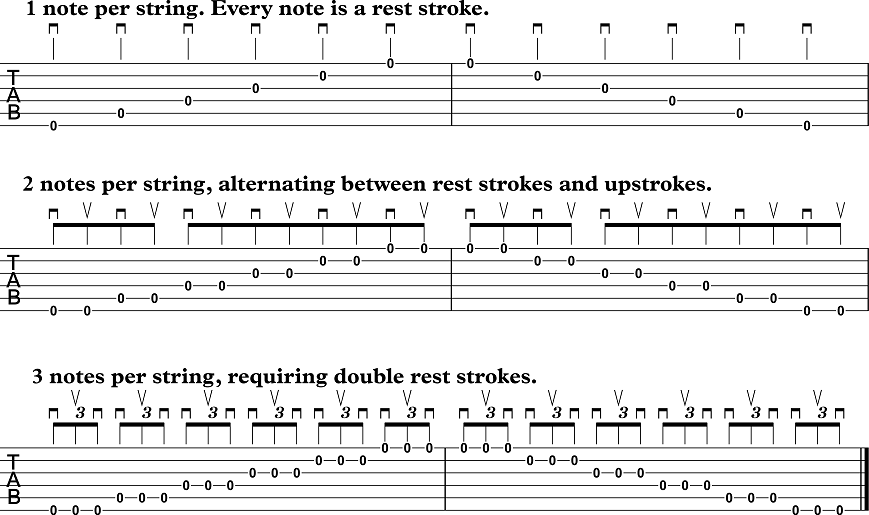
To get used to this technique, try the following exercises using open strings. Don’t forget to use rest strokes.

An Introduction To Gypsy Jazz Lead Guitar Picking Exercises

Applying Gypsy Jazz Guitar Picking To Melodies

The best way to get comfortable with gypsy jazz picking is to apply this new technique directly to learning a melody. This way you also get to start building up a repertoire of classic gypsy jazz tunes that you can play.


Check out the following FREE video lesson, taken from the course Lead Guitar Fundamentals at Studygpsyjazz.com. In this lesson you will learn the melody to the popular gypsy jazz standard ‘Dark Eyes (Les Yeux Noirs).’ Dark eyes is a classic gypsy jazz anthem consisting of a short 16 bar form. The melody is generally played at least twice before moving to sections of improvisation.

In the video below, the melody is demonstrated in full, and then the picking and fingering are broken down for you to learn.


Building Up A Vocabulary Of Tools For Improvising

Another important aspect of gypsy jazz lead guitar playing is to begin developing a vocabulary of tools for improvising, namely tools that are typical of the genre, and help you achieve ‘Django-like’ colours over the chord changes as you improvise.

Using arpeggios of the chord changes that are passing by is an improvisation approach that was favoured by Django. Django would often add embellishments to these arpeggios, whilst clearly outline the chord changes.

One of the most common and useful arpeggios in gypsy jazz is the ‘Multi Purpose Arpeggio.’ This arpeggio can be used over minor 6 chords, dominant 7th/9th chords, and minor 7b5 chords. The arpeggio outlines each of these of these chords, depending on which note in the arpeggio is considered as the root note.

Check out the following FREE video lesson to learn this very useful arpeggio. This lesson is again taken from the course Lead Guitar Fundamentals at Studygpsyjazz.com. The video includes on-screen notation, with picking directions and fingering to help you master the arpeggio at your own pace.

There’s Much More To This Exciting Style…

There’s so much more to learn when studying gypsy jazz lead guitar. Hopefully the above exercises and lessons have helped you get started and given you a taste of the genre.

If you’d like to pursue studying this style, please check out our comprehensive video courses at studygypsyjazz.com. You can also find gypsy jazz backing tracks and e-books.

All the best and have fun,

Harry Edwards
(Gypsy Jazz Guitar Tutor @ Studygypsyjazz.com)


Harry Edwards is a guitarist, performer and teacher from Tasmania, Australia. Harry holds a B.Mus. and has studied gypsy jazz extensively throughout Europe and the U.S.A. He teaches gypsy jazz guitar online at www.studygypsyjazz.com

Studygypsyjazz.com provides comprehensive gypsy jazz video tuition, as well as e-books and professionally recorded backing tracks.

The post An Introduction To Gypsy Jazz Lead Guitar appeared first on The Guitar Journal.

Wednesday, August 3, 2016

The Fundamentals of Filming a Music Video

Filming your first music video as a musician can be an exciting yet daunting experience, particularly when you don’t know what to expect. Here, the Directors of Epik Music Videos, Andy and Tai have answered some of the most common questions they are asked by their clients.

The Fundamentals of Filming a Music Video


How much should I expect to pay for my music video?

Andy: The saying “you get what you pay for” is highly relevant here. It is common for music video production companies to vary in terms of their minimum costs and most people tend to sway more towards the cheapest option. However, be realistic in what you envision the outcome of your video to be like and have an adequate budget for the creatives to meet your vision.

Tai: Totally agree. It’s really a combination of the concept of your video and your decided budget. Any decent music video production company will come up with ideas which reflect your personality without overstepping your budget, so it’s a good idea to have an ideal budget in mind, but be flexible with it when deciding what you want.

Hopefully this answer will show you that pricing isn’t as straightforward. Keep reading for more information!

What determines the cost of the music video?

Tai: The content of your video will be the main influence of the cost of production. Driving around London in a Rolls Royce throwing money around will evidently cost more than a green screen video. However, there many other production elements you will need to consider, including things like:

  1. The location,
  2. Equipment needed,
  3. Crew required,
  4. Hair stylist etc.

Andy: To give you a more definitive answer, you’re looking at around £1,500+ for a basic music video, or £300+ for a basic Lyric Video. But a chat with your chosen Music Video Production company will tell you how much you’re looking at for specific ideas and extras, so get in touch! Alternatively, read this article for a bit more advice: How Much Does a Music Video Cost?


Find out where your money goes, decide your maximum budget and then you can decide on a concept which meets this.

How detailed does the brief have to be?

Andy: Writing a brief for a music video is vital if you, as a musician, want yours to reflect who you are effectively. Firstly, you will need to decide how much you are willing to spend to know what type of video you can afford. The brief will need to be detailed enough to give the director enough information to come up with a concept, whilst giving the production company a rough estimate of how much it is likely to cost.

Tai: Your background, how you want to be perceived, your audience, previous music and videos etc. Basically, the more information, the better! If your budget is limited, we recommend you state this upfront as a reputable music video production company will be happy to work towards this. We would also recommend providing examples of music videos you like to give a better idea of the style you are looking for.

behind-the-scene-at-the-film-studiosHow do I choose the right director?

Andy: The relationship between the artist and the director is key! You should always choose the Director who shares a similar vision or at least understands the vision you have for your music video. The relationship between you and the Director is also integral for a smooth shooting day and a great result, so meeting them in person is important.

Tai: Creativity plays a part of this, can they interpret the song lyrics like you do?  Aside from this, there are many qualities to consider when looking for the best Music Video Director: passion, strong leadership, editing skills and knowing the medium well are all checkboxes you should use to determine whether a Director is worth their salt!

How do I determine how many crew members I need to produce a Music Video?

Andy: The treatment and general plans for your video will form the basis of costs, so identifying your concept ideas and budget will be crucial in this. A treatment is a document which the Director uses to communicate their concept idea to the artist.

Tai: These two factors define the production crew you will need: the more complex the concept, the more crew you will need. For example, if you require a set to be built, you will need set builders. Decide a budget and go from there.

What basic equipment do I need to hire?

Andy: Put simply? Camera. Playback. Director. Location. The concept and resulting treatment for the music video will determine what other equipment is needed. Are you in a studio and need special lighting or are you filming outside? What camera is the Director using, and does this require different lenses? Do you need to build a set? Green screen music videos are often filmed quite minimally, with the special effects added in post-production.

Tai: Your production company will help you get the best equipment for your needs, so concentrate on the concept you want and the rest will fall into place.

How is a shooting day organised?

Tai: This is the responsibility of the production team who organise the day based on the shot list, which is inspired by the treatment. A typical shooting day will start off with an on-location run through to confirm shot angles, lighting set ups, character positions etc. Then, for practical reasons, all scenes with the same lighting, makeup, location etc. will be shot together to save time. The Director will take “test takes” with stand ins to get the lighting and composition right, and then you will more than likely want to rehearse your performance before you begin shooting for real.


A Treatment is the Directors written expression of how the video will be constructed and how it will look.

How would I go about organising all my crew during filming?

Andy: It is the job of the Producer and Director to turn the treatment into a production by identifying exactly what needs organising. You, as the artist, won’t have to worry about a thing.

What do you have to consider when researching, choosing and securing a location for filming a music video?

Tai: Filming days are often very long and demanding. Is the location affordable and available when you need it? Can it be lit properly? Is the location easy for everyone to get to? Will there be electricity points available? All of these questions can be answered by organising a “recce” – a viewing of the chosen location to give a better idea of how everything will be set up and to diagnose any potential problems etc.

Andy: Insurance is often needed for location shoots, but the Directors will handle this for you. All you need to think about is whether the location is the right look for your music video and the right price for your budget. All the practical issues will be the responsibility of the Producer and Director as they will have their treatment to hand to help identify any requirements or issues.

digital-cameraHow do I set and manage timelines and deadlines?

Tai: Similarly, this is the job of the Director and Producer. They will often intentionally overestimate how long things will take to complete. This is to ensure a little bit of leeway so everything is done either when it is meant to be, or before. Why? Well firstly it is good practice for life in general, but mainly because it would be incredibly expensive to organise a reshoot day!

How do I keep track/ensure the budget/deadlines are being met?

Tai: Although this is primarily the responsibility of the Producer who will only shoot to budget; we would suggest managing your budget on a spreadsheet yourself. By doing this, you can firstly communicate any problems with your Director and Producer straight away, but this also enables you to identify if there is enough budget for any extras.

Can old footage be incorporated into the music video?

Tai: It sure can! Haim’s music video for “Forever” is the perfect example of using old footage of them integrated with present day footage, and it is an awesome video! It is easy to do with the right soft and hardware, and wouldn’t cost any more unless it is VHS footage. A skilled editor can easily integrate them both seamlessly.

What is the best format to use for a Music Video?

Andy: Platforms such as Facebook, YouTube and Myspace typically accommodate most file formats. However, there are many other factors you will have to think about: compatibility with different players, file size, loss of quality and such. MP4, H264 10ATP or .mov, a QuickTime movie file are your best bet for distributing online.

What is the best software for editing a music video?

Tai: In our experience, there are 3 unbeatable heavyweight editing tools:

  1. Apple’s FinalCut Pro,
  2. Adobe’s Premier and
  3. Avid.

You have to pay for these, but they are by no means restricted to professionals – they just require a little training. It is worth the money if you are editing your own music video.

Who owns the rights to the music video? Artist/Producer/Record Label?

Andy: That’s simple. Whoever paid for the music video has the right to do what they like with it. As a musician, it is vital that you are aware of the Copyright Act and how to protect your Music in the UK, so get on it!

How do I get the video to the target audience?

Andy: To start out with, we would recommend sending your shiny new music video to a small circle of friends, getting their opinion and then communicate any changes to your Director and Editor. We are always happy to tweak your video for no extra costs. When everything is perfect, this is where the fun starts. There are plenty of ways to promote your music online, social media and your own website being the most obvious. Successfully promoting your music on social media is a sure fire way to get yourself heard with your target audience, but having your own website is your most valuable asset.


Read Full Article Here: http://www.helpforbands.co.uk/fundamentals-filming-music-video/